
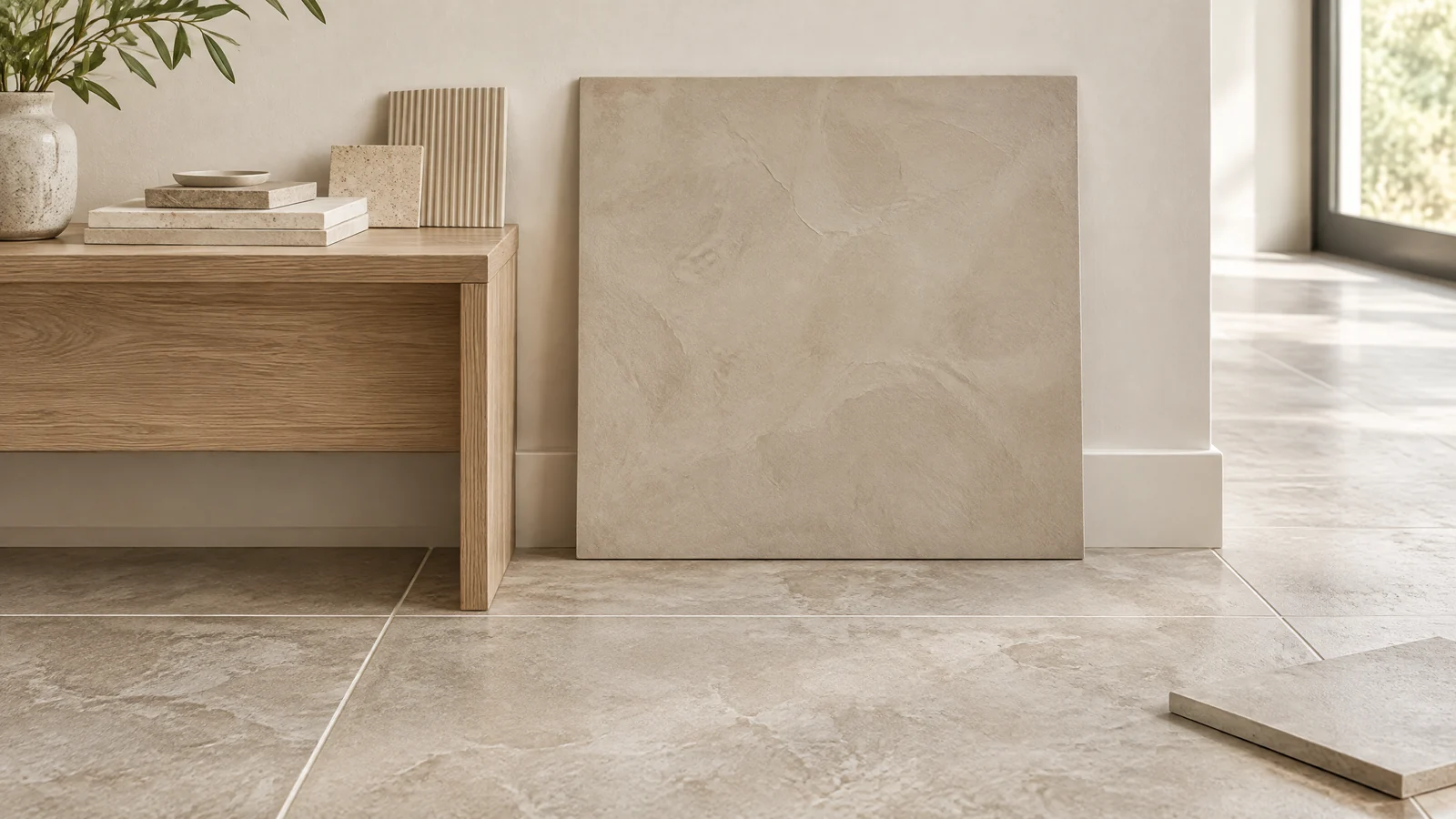
Existing tile can sometimes remain in place beneath a microcement finish, but it is not automatically a good substrate. If the tile is loose, hollow-sounding, cracked from movement, uneven, contaminated by old coatings, or part of an unresolved moisture issue, an overlay may hide the evidence rather than solve the condition. Before requesting scope for a Dallas project, treat the tile as an assembly to evaluate—not simply a surface to cover.
Start with the question underneath the tile
An overlay depends on the tile staying put and on the surface below it remaining stable.
Broad substrate guidance points in the same direction. MAPEI says supporting surfaces should be structurally sound, solid, stable, flat, plumb, and true, and its existing-flooring guidance calls for ceramic and porcelain tile to be securely bonded, stable, clean, and dry. Read MAPEI’s surface-preparation requirements. Those are general installation principles for MAPEI systems, not a specification for an Accent Wall of Art project or a remote verdict on a particular room.
Soundness: loose, hollow, cracked, or shifting tile
Tile needs to be attached to a stable base before it can serve as a base for another finish. A tile that moves when pressed, a broken edge, missing grout associated with movement, or a tile that can be removed without effort is not a detail to coat over. Meoded’s Concretta FS product guidance says existing tile must be clean, dry, stable, well-bonded, and properly prepared; it directs that loose, cracked, hollow, or damaged tile be repaired or removed before microcement is applied. See Meoded’s Concretta FS tile guidance.
A hollow sound from a tap is an observation, not a diagnosis. It may merit closer examination because it can be associated with a void or reduced attachment, but it does not tell an owner exactly what is happening below the tile. Avoid treating a quick tap test as proof that an entire wall or floor has failed. A qualified assessment should consider the extent and pattern, the tile’s response to light pressure, cracks, grout condition, and the surrounding construction.
Cracks deserve the same caution. A hairline in a tile, a crack that continues through several tiles, or a repeated crack near a change in material may reflect different causes. The question is not whether a filler can make the face look smooth. The question is whether the cause has stopped and whether the base is suitable for the chosen system. If movement remains active or cannot be understood, removal and rebuilding the affected assembly, or further investigation before any finish decision, is usually a more defensible conversation than simply adding layers.
Movement joints are not ordinary grout lines
Not every line in a tiled surface serves the same purpose. Some grout joints separate individual tiles. Other joints or cracks accommodate building movement, changes in direction, or transitions between materials. Covering every line as though it were cosmetic grout can remove the visible cue without eliminating the movement that created it.
ARDEX’s tile-system guidance says to honor joints and cracks as needed and to incorporate movement joints. It also states that expansion joints must be provided over existing moving joints and moving cracks and where substrate materials change composition or direction. Review the ARDEX technical data sheet. That is ARDEX guidance for its own mortar system, not a microcement specification. The transferable principle is modest but important: an apparent joint can carry movement, so it should be identified rather than casually buried.
Bring attention to changes of plane, perimeter edges, thresholds, transitions from tile to another material, and any line that reappears after past repairs. Ask whether the line is a movement joint, a crack, a grout joint, or an unknown condition. A proposal should describe the intended treatment of each relevant detail. If the answer is only that every line will disappear, the owner still needs to know how movement and perimeter transitions are being addressed.
Flatness and grout relief: assess the profile, not just the pattern
An overlay is thin. It does not turn pronounced lippage, low spots, recessed grout, chipped edges, or an out-of-plane wall into a reliably flat base by itself. The finished look may depend on how much correction is needed before the finish coats begin. On floors, the existing slope and the relationship to drains, adjoining rooms, and fixed elements also matter.
Topciment’s old-tile application article says that tiles with imperfections need substrate repair before coating. It also explains that unfilled joints can leave unevenness and allow joints to mark through. Read Topciment’s tile-overlay preparation article. Those particular materials and steps belong to Topciment’s system, not to every microcement product. They support the assessment question, however: is the tiled field sufficiently level and consolidated for the selected system after any planned preparation?
In a walkthrough, a straightedge or similar method can reveal more than a photograph. The aim is not for an owner to assign a technical tolerance. It is to make the surface profile part of the quote conversation. Ask where buildup will be added, whether tile edges or deep grout require correction, and how the proposed work will preserve intentional drainage where it already exists. A quote that separates localized repair, plane correction, and finish application is easier to understand than one broad promise to make tile seamless.
Previous coatings and bond breakers need a real answer
Visible tile can carry years of wax, soap film, grease, cleaners, silicone residue, paint overspray, topical sealers, or an unknown coating. These are not all equivalent, and a surface that looks clean may still have a layer that affects adhesion. Cleaning is necessary, but it is not proof that every prior treatment has been removed or made compatible.
MAPEI lists dust, oil, grease, paint, wax, primers, sealers, old adhesive residue, and other substances that can reduce adhesion or performance. ARDEX likewise calls for sound, clean substrates free of bond-breaking contaminants, including wax, grease, paints, oils, sealers, and unsuitable residues. MAPEI’s list and ARDEX’s list are guidance for their respective systems. They are useful reminders to identify the condition rather than assume a universal cleaner or primer fixes it.
System instructions can differ materially here. Meoded’s current Concretta FS tile/marble instructions identify cleaning and removal of loose or flaking grout material, and say that Concretta FS is formulated to bond directly to tile and stone without a primer. Topciment’s cited article describes an adhesion promoter for its own tile-overlay process. That difference is a reason to ask for the named product system and its current written preparation instructions, not a reason to combine steps from several brands. If a coating, sealer, or cleaning history is unknown, a qualified applicator may need to determine whether it can be prepared, isolated using a compatible approved method, or removed.
Water management is a separate go/no-go issue
Existing tile does not reveal whether a shower, tub surround, floor, or other wet location has a sound concealed water-management assembly. Staining, soft adjacent materials, persistent odor, recurring efflorescence, missing caulk at changes of plane, or water that behaves unexpectedly around a drain should prompt an assembly question before an aesthetic overlay discussion.
This does not diagnose a particular tiled bathroom; it defines a scope boundary. Meoded’s Concretta FS technical data sheet says, for shower or moist-area use, to waterproof the substrate before application because Concretta FS is only the finish-coat plaster. Read the Concretta FS technical data sheet. That manufacturer statement does not establish an existing shower’s condition or validate another system.
If the existing tile is in a direct-wet area, ask what information is known about the backing, membrane, drain connection, plane changes, penetrations, and any prior leak history. An overlay scope should not quietly convert an unknown concealed assembly into an assumed acceptable one. For broader finish selection by bathroom exposure zone, see Luxury Bathroom Wall Finishes Beyond Tile.
Finished buildup changes details at the edges
Even a relatively thin finish changes the surface plane. The practical question is not simply whether an overlay avoids removal; it is what the new plane meets. Door clearances, baseboards, cabinetry, trim, floor transitions, outlet covers, plumbing trim, shower glass, niches, thresholds, and adjacent materials may each need a defined finish detail.
This matters especially when the tile is already proud of a neighboring surface or when a floor edge must meet another finished floor. A level correction can add more buildup than the finish itself. At vertical details, an overlay may need to stop, return, or transition in a way that is visible and intentional. Ask to see how edges and changes of plane will be handled before approving a scope, rather than discovering the decision after surface preparation has begun.
| What you notice | Why it matters | Best next conversation |
|---|---|---|
| Loose tile, widespread hollow sounds, broken edges, or recurring cracks | The visible tile may not be a stable base. | Ask for investigation and defined repair or removal options before finish scope. |
| A line at a perimeter, change of plane, material change, or prior crack repair | It may be a movement detail rather than ordinary grout. | Ask how it will be identified and treated in the selected system. |
| Deep joints, lippage, low spots, or an uneven wall | Thin finish layers may reproduce the profile unless the plane is corrected. | Ask what preparation is included and how it affects transitions. |
| Glossy tile, old sealer, wax, unknown cleaner, or residue | Bond depends on system-specific preparation and compatibility. | Ask for the named product instructions and the proposed preparation method. |
| Signs of moisture trouble or a wet area with unknown construction | The finish decision cannot substitute for evaluating the underlying assembly. | Clarify the water-management condition and responsible trade before overlay work. |
When to remediate, remove, or consider an overlay
There is no one rule for every tile surface. An overlay may be worth considering when the tile is firmly bonded, stable, clean, dry, reasonably flat after specified preparation, and compatible with a named manufacturer system. In that situation, the pre-quote discussion can move from general possibility to documented details: preparation, joints, reinforcement if the selected system calls for it, edge transitions, and the exact finish area.
Remediation and reassessment make more sense when problems are limited and the cause can be addressed. That might include correcting localized tile or grout damage, dealing with a known surface contaminant by an approved method, or defining a needed plane correction. The key is not to label every small repair a reason to demolish. It is to avoid calling repair complete before the base and the next layer are both evaluated.
Removal, rebuild, or further investigation becomes the more responsible path when the tile is broadly unstable, movement appears active, the surface is substantially out of plane for the intended detail, water-management concerns are unresolved, or the cause of the condition cannot be identified well enough to write a reliable scope. This is an assessment framework, not a remote diagnosis or a guarantee of a particular result.
What to request before an overlay quote
For a focused discussion of a proposed microcement finish, provide clear photos of the full surface, close-ups of cracks or grout loss, views of every edge and transition, and a short note about the room’s use and any known repair or moisture history. Then ask the estimator to distinguish what is included in substrate preparation from what belongs to another trade.
- Name the exact microcement product/system being proposed and use its current written instructions.
- Identify areas of loose, hollow, cracked, or damaged tile and the proposed disposition of each.
- Describe how movement joints, cracks, corners, and other changes of plane will be handled.
- State what preparation addresses grout relief, lippage, flatness, and finished buildup.
- List known or suspected bond concerns such as sealers, wax, silicone, cleaners, and prior coatings.
- For wet areas, define what is known about the existing assembly and what is outside the finish scope.
- Show the intended termination and transition details before work starts.
Owners planning a project in Dallas can use that checklist to request a more comparable scope instead of a generic promise to coat over tile. To discuss whether an assessment is appropriate for your surface, use the contact page or call (972) 845-4896. More finish-planning guidance is available on the Accent Wall of Art blog.
Frequently Asked Questions
Can microcement go over tile that only has a few damaged spots?
Possibly, but the relevant question is whether the damage is isolated and whether its cause can be corrected before the new finish is applied. A small chip is different from repeated cracking, loose tile, or a hollow area. The assessment should define the repair and then reconsider the soundness, flatness, and transition details.
Does a hollow-sounding tile always mean the tile must be removed?
No. A hollow sound is an observation that can justify closer review; it is not a remote diagnosis of the cause or the extent of a condition. Meoded’s product guidance lists hollow or damaged tile among conditions to repair or remove before its product is applied, but the appropriate action on a specific surface depends on the evaluation and the selected system’s instructions.
Can grout lines simply be filled before microcement is applied?
Filling grout relief may be part of a system’s preparation, but it is not a universal fix for movement, loose tile, or an uneven plane. Topciment’s tile-overlay guidance addresses filled joints as a way to reduce unevenness and joint marking in its process. The method and materials must match the named system, and a movement joint should not be treated as ordinary grout.
Does an existing tiled shower make a microcement overlay suitable?
Not by itself. Existing tile does not verify the condition of the backing or concealed water-management assembly. The selected finish system, the substrate condition, the wet-area details, and the scope boundaries all need to be considered before an overlay decision is made.
What is the most useful information to send for an initial assessment?
Send wide and close photos, the surface location, approximate area, any history of cracks or repairs, notes about moisture or drainage concerns, and images of doors, fixtures, drains, and adjoining surfaces. Those details help frame the onsite or project-specific questions; they do not replace direct evaluation.